An unidentified organic mass of flesh washes onto shore. This isn’t like a regular beached carcass, however, as it seems to be no known creature (or at least unidentifiable).
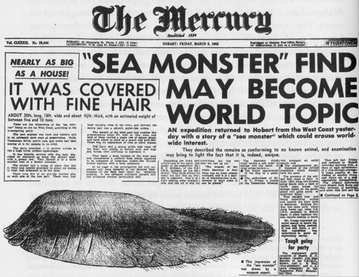
Globsters are a special kind of cryptid in that there’s hard evidence of them existing: their actual corpse!
The problem is that corpse is unidentifiable, thus making it hard to prove it’s a rare creature and classifying it as a cryptid instead.
When the term was coined in a 1962 report, the globster involved had “soft, tusk-like protuberances” where a mouth would be and lacked eyes.
However this globster was later identified as a whale in 1981, and later confirmed as such by using electron microscopy to analyse the creature’s collagen fibers.
In fact, a lot of globsters turn out to be whales or parts of whales. The St. Augustine Monster, another famous globster, was simply gobs whale blubber.
Advances in science lets us finally test these beached corpses and see what they actually are.
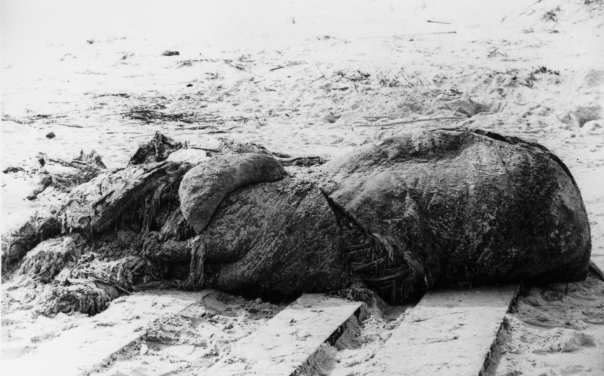
Due to these advancements, however, it’s likely that the idea of a globster cryptid will be phased out. No longer will these heaps of meat be unidentifiable monsters: they’ll probably just be gross whale bits instead.
Images from WikiMedia Commons. All images on this site are free usage!
 Cryptopedia